
Conscious business
What is an operational management system and when does a company need one?
An operational management system keeps leads, quotes, projects, tasks and stock in one place. Learn what it does and when a company needs one.
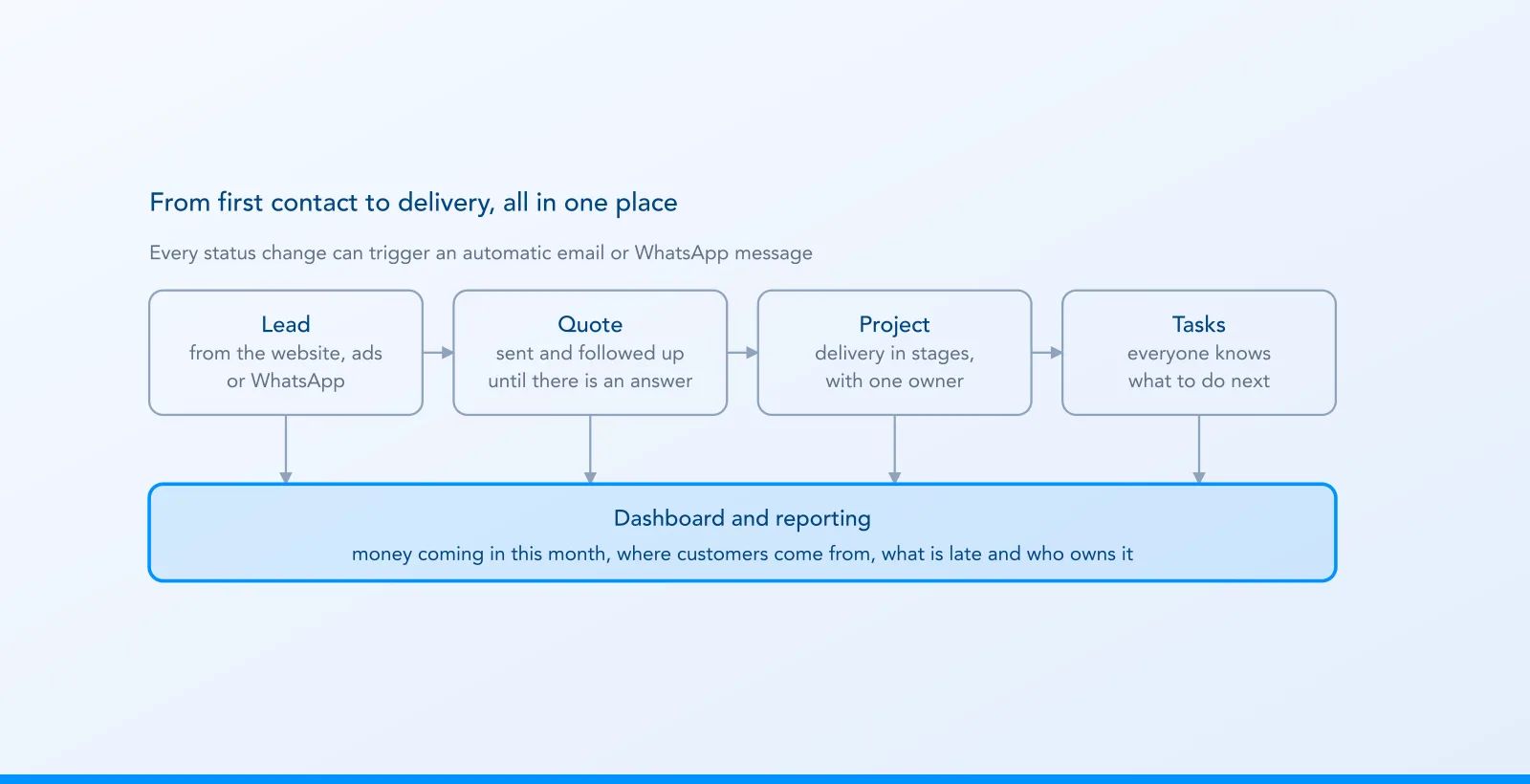
In short: an operational management system is the software where a company keeps everything that happens day to day in one place: potential customers (leads), quotes, projects, team tasks, stock and the numbers that show how the business is doing. A company needs one when the important information lives in the heads of two or three people, in separate spreadsheets and in WhatsApp chats, and the owner only finds out about problems at the end of the month.
The difference from a plain CRM: a CRM tracks the sale. An operational management system also tracks what happens after the sale: delivery, people and money.
What does an operational management system actually do?
It follows a customer's whole journey through the company, from the first message to delivery, and shows on a single screen where everything stands. The core modules are the sales pipeline (leads and quotes), projects, tasks, notifications, stock and reporting.
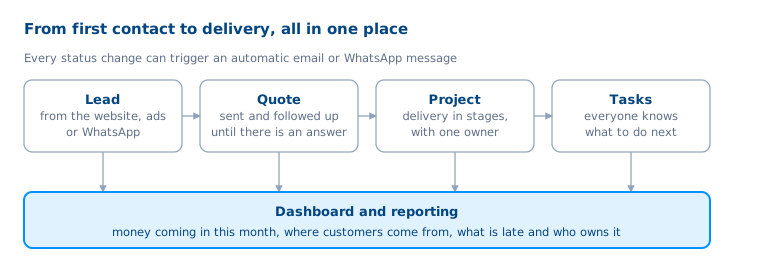
Every stage feeds the dashboard, so the owner no longer asks for reports: they can see them. When a lead changes status, the system can send the right message automatically, by email or on WhatsApp.
How is it different from a CRM, an ERP or a spreadsheet?
A CRM answers the question "who are we selling to?". An ERP answers "how do we run accounting and stock?". An operational management system answers "what is happening in the company today, and who is handling it?". For a small or mid-sized company the three overlap a lot. The practical difference is what each one covers and how hard it is to get it running.
The full comparison, with a table and diagrams, is in CRM or ERP? The difference, and what a small company actually needs. What each option really costs, hidden costs included, is in How much does a CRM cost for a small company?.
In short: if your problem is only sales, a CRM is enough. If the problem is that you cannot see the whole company, from the first contact with a customer to getting paid, you need an operational management system.
When does a company need an operational management system?
A company needs one when it has at least 5 people and the information about customers, projects and money no longer fits in the owner's head. Here are seven concrete signs:
- You do not know today how many quotes are open and what they are worth.
- Leads from ads or the website are copied over by hand, or get lost.
- Someone builds the reports by hand, in Excel, at the end of the month.
- When a colleague is away, nobody knows where they left off with their customers.
- Customers often ask "what is happening with my order?".
- The team works across WhatsApp, email and Excel, and the information does not connect.
- You only find out about problems at the end of the month, when it is too late to fix them.
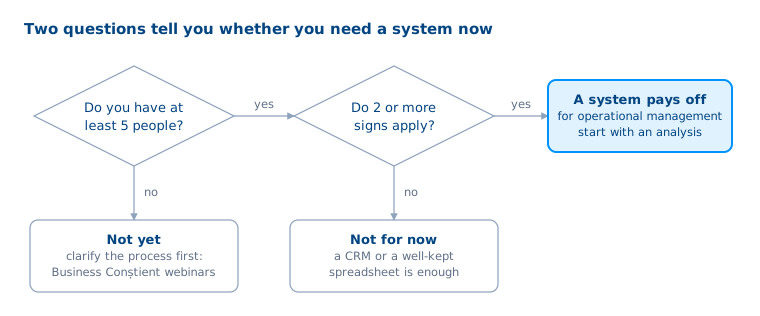
A simple check: do you know how much money is coming in this month and where your last ten customers came from? If the answer takes more than a minute, a system would make a difference.
How we realised we needed one ourselves
At AITEH we went through this before we built BizAITEH. People were talking to customers, they had leads, they had calls to make. And still nothing moved. Projects were started, and when we said "let's invoice", we found out we could not, because there was still a lot of work left.
The problem was that I could not see what was happening in the company without asking. That is how BizAITEH came about, and today it runs our own company.
We hear the same situation in almost every first conversation with an entrepreneur:
"The business is going well, but I have no time. I need to work out how to get more time, but not now. I'm not even clear on what we should do. Let's talk later."
The lack of time usually comes from a lack of visibility. When you cannot see the company clearly, everything goes through you.
When does a company NOT need one yet?
Not every company needs an operational management system. We will tell you plainly when it is not worth it:
- You have fewer than 3 people and all the information fits into a single working day.
- You do not know yet which problem you want to solve. A system does not fix a process that does not exist; it only makes it visible.
- Nobody in the company has time to use it in the first weeks. Software that is installed and not used is the most expensive software there is.
In these cases, a good first step is to get clear on how the company works today. That is what our Business Conștient webinar series is for.
Example: what it looks like in practice at ADEVĂR
ADEVĂR is an association in Romania that helps road accident victims claim compensation, free of charge. Every case starts as a lead (from social media or the website) and becomes a file that moves through several stages.
Before BizAITEH, ADEVĂR worked in Excel, then in a mini-CRM, then in Excel again, then in another system and then back in Excel. Each time a system did not fit the way the team worked, Excel went back to being the place where the files were kept.
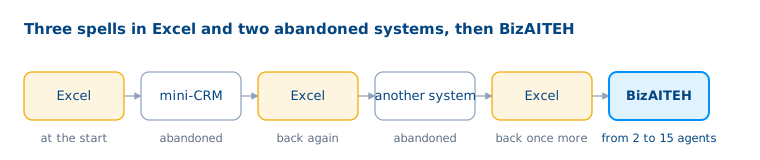
In BizAITEH, the operational management system built by AITEH, leads from social media and the website come in automatically, without being copied by hand. Files and leads are tracked in the same flow, and every agent can see what they have to do. With this system behind it, ADEVĂR's sales team grew from 2 to 15 agents.
How long does implementation take, and how much of the team's time?
With BizAITEH, implementation takes between 2 and 8 weeks, depending on how much data we import and how many flows we configure. The company's team invests 2-3 hours in total: one conversation about how they work today, approving the configuration, and the training. We handle the data import, configuration and setup.
- Analysis: we look at the company first. How customers come in, who does what, where time gets lost.
- Import: we bring the existing contacts, quotes and projects into the system.
- Configuration: the sales stages, the email and WhatsApp automations, the reports.
- Training: the team learns on its own data, not on generic examples.
- The first weeks: we watch how it is used and adjust whatever does not work.
Frequently asked questions
What is an operational management system?
It is the software where a company tracks leads, quotes, projects, tasks, stock and reports in one place. Its purpose is to let the owner see what is happening in the company at any moment.
From how many employees is it worth it?
Usually from 5 people upwards. Below 3 people, the information still fits in a well-kept list.
Does it replace accounting software?
No. Accounting and tax invoicing stay in dedicated software. The operational management system covers everything that happens before and around the invoice.
How much does BizAITEH cost?
The BizAITEH licence costs €300 per month for up to 50 users, and standard implementation starts at €500. Prices exclude VAT. Special integrations and custom modules are estimated separately.
Is BizAITEH built for companies in Romania?
Yes. BizAITEH is built in Romania and works with Romanian company data (CUI tax ID, the Trade Register, counties) and local tax requirements, with support in Romanian.
Who owns the data?
The data and any custom development belong to the client. There is no vendor lock-in.
Do you use the system yourselves?
Yes. BizAITEH runs our own company. We only build what we would use ourselves.