
Sales and customers
CRM or ERP? The difference, and what a small company actually needs
The difference between a CRM and an ERP, the gap between them, and what a company with 5-50 people needs: a CRM, an ERP or an operational management system.
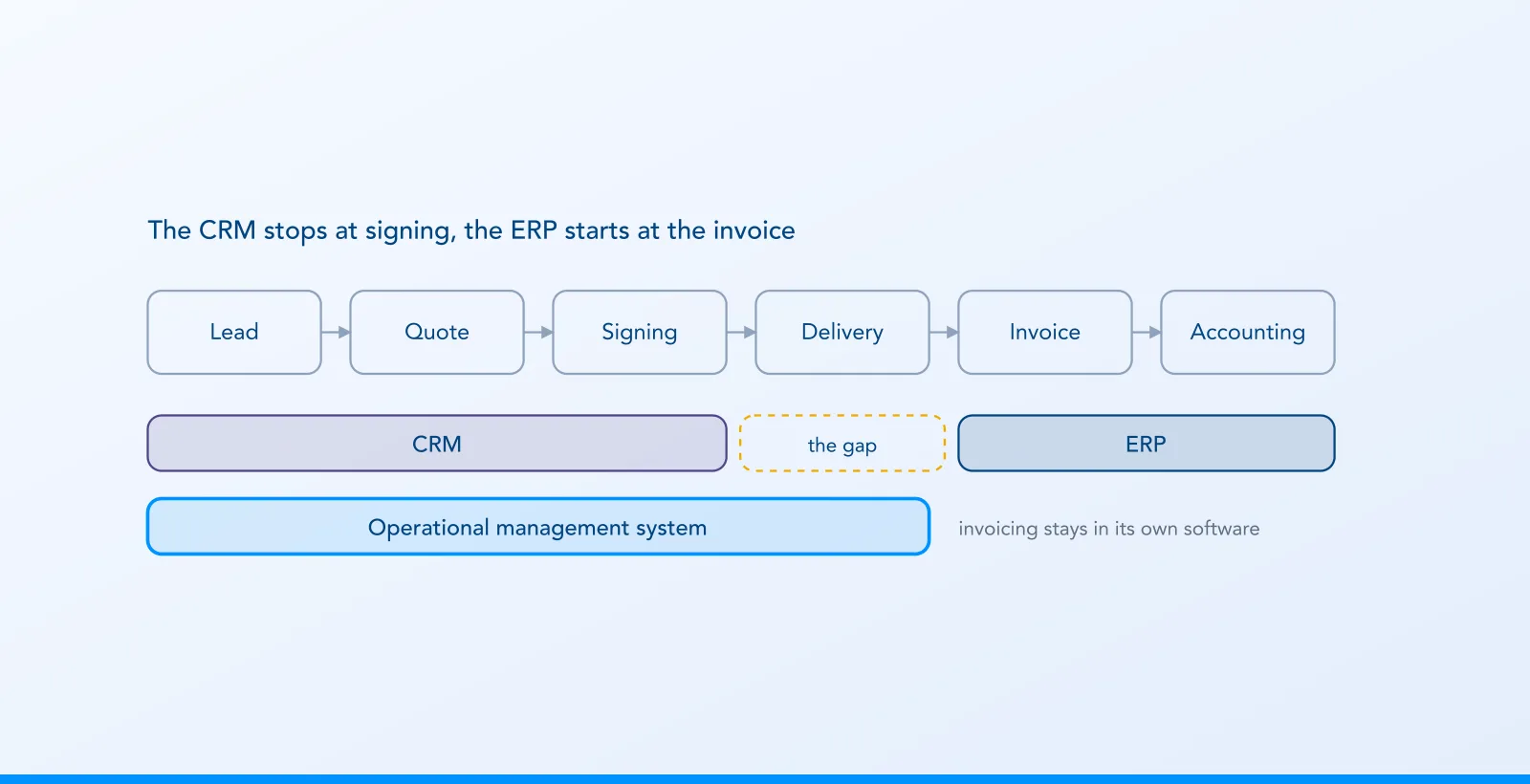
In short: a CRM tracks the relationship with customers, from first contact to the sale. An ERP tracks the company's resources: accounting, stock, production and purchasing. The CRM looks outward, the ERP looks inward.
Between them sits a gap that few small companies notice in time: everything that happens after the customer has said "yes" and before the invoice. Delivery, projects, the team's tasks. That is where an operational management system comes in. For a company with 5-50 people, this middle part is usually exactly what is missing. A large ERP is rarely the first problem.
What is a CRM?
CRM stands for Customer Relationship Management. A CRM holds contacts, leads, quotes and the history of conversations with each customer. It is used mostly by sales and marketing. It answers the question: "Who are we selling to, and where did each conversation leave off?" What one really costs, hidden costs included, is in How much does a CRM cost for a small company?.
What is an ERP?
ERP stands for Enterprise Resource Planning. An ERP connects accounting, stock, purchasing, production and sometimes human resources. It is used mostly by finance, the warehouse and production. It answers the question: "What do we have, what does it cost us and what do we need to order?"
A concrete example: for Romscent, a European distributor of perfumes and cosmetics, AITEH built the ERP behind the business. The system keeps the stock, applies prices per customer and per brand, and creates shipping labels automatically.
Where does a CRM stop and an ERP begin?
Follow a customer's path through the company: lead, quote, signing, delivery, invoice, accounting. The CRM covers the first half. The ERP covers everything from the invoice onwards, plus stock and purchasing. Delivery, projects and the team's work often stay out of sight.
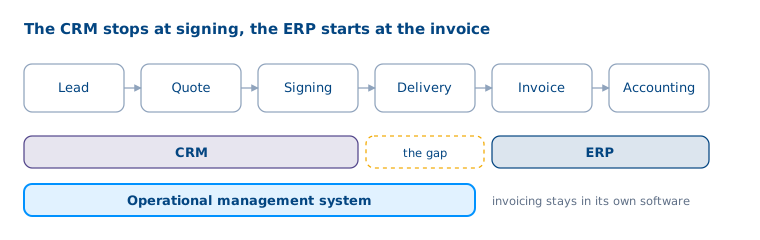
This is where most small companies lose time: the sale is in the CRM, the invoice is in the invoicing software, and everything in between lives in Excel, email and WhatsApp.
CRM, ERP or operational management system: what is the difference?
| Criterion | CRM | ERP | Operational management system |
|---|---|---|---|
| The question it answers | Who are we selling to? | What resources do we have, and what do they cost? | What is happening in the company today, and who is handling it? |
| What it tracks | Contacts, leads, quotes | Accounting, stock, purchasing, production | Leads, quotes, projects, tasks, stock, reports |
| Who uses it every day | Sales, marketing | Finance, warehouse, production | The owner and the whole team |
| Where it stops | At signing | Does not cover sales in depth | Does not replace accounting software |
| Implementation | Usually quick | Usually long and expensive | With BizAITEH, 2-8 weeks |
| Good for | Teams that sell a lot | Companies with complex stock and production | SMEs with 5-50 people |
For a small company, the last column is usually closest to what people mean when they say "I want a CRM" or "I want an ERP": one place where the owner can see the whole company.
What does a small company actually need: a CRM or an ERP?
Start from where you are losing time or money today, not from the name of the system. Many entrepreneurs say "I want a CRM" or "I want an ERP" and are really describing a problem in the middle: they do not know what happens after the customer has signed.
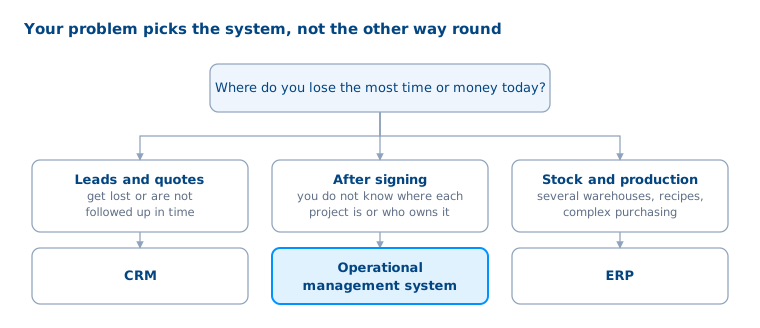
Most of the time, a company with 5-50 people does not need a full ERP. It needs one place where sales, delivery and the team can be seen together, while invoicing can stay in the software it already uses.
Frequently asked questions
What is the main difference between a CRM and an ERP?
A CRM manages the relationship with customers and the sale. An ERP manages internal resources: accounting, stock, purchasing, production.
Do I need a CRM or an ERP?
If you are losing leads and quotes, a CRM. If stock and production are complicated, an ERP. If you cannot see what happens after signing, an operational management system.
Can I use a CRM and an ERP together?
Yes. In large companies the two are usually connected, so customer data is not entered twice.
Does an ERP replace accounting software?
A large ERP usually includes accounting. In small companies, invoicing usually stays in dedicated software (in Romania, for example SmartBill or Oblio), and the accounting stays with the accountant.
Is BizAITEH a CRM or an ERP?
Neither. BizAITEH is an operational management system: it has the sales side of a CRM, plus projects, tasks, stock and reports, without the complexity of an ERP.
What suits a company with 10-30 people?
Most of the time, an operational management system plus the invoicing software it already uses. A full ERP becomes necessary when stock, production or the number of legal entities grows a lot.