
Processes and automation
Custom software or an off-the-shelf product: how do you choose?
When to choose an off-the-shelf product and when custom software is worth it. The real risks, a decision diagram and the Laundromat example.
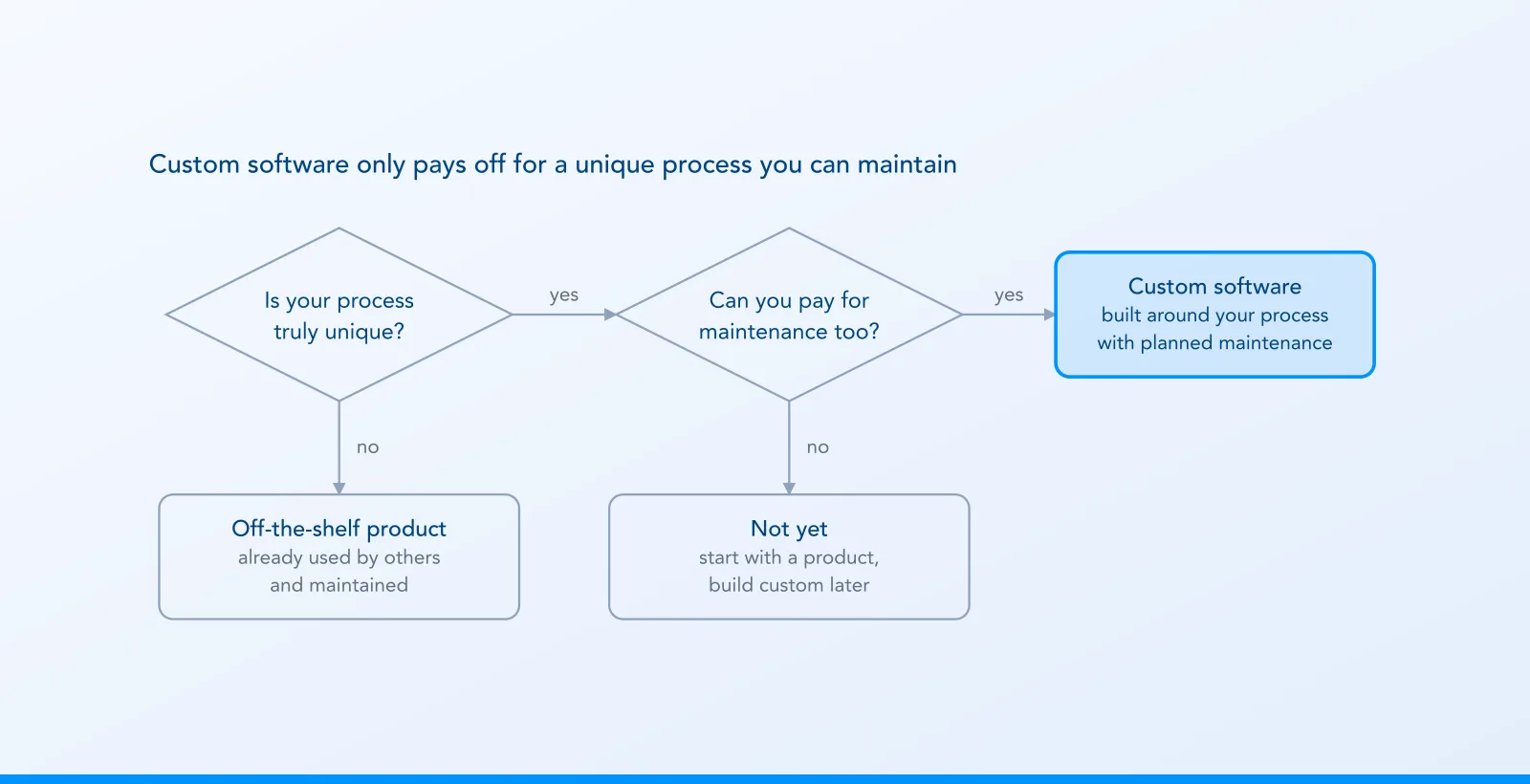
In short: choose an off-the-shelf product when your process looks like other companies' processes. The product is already used by many, you can see it before you buy it, and someone maintains it. Choose custom software when the process is specific to your company, nothing on the market covers it, and you can pay for building it and, above all, for maintaining it for years.
In AITEH's experience, most entrepreneurs at the start of the road need an off-the-shelf product, not custom software. Even though we build custom software (AITEH NexFlow), we have advised many clients not to do it.
How does an off-the-shelf product differ from custom software?
| Criterion | Off-the-shelf product | Custom software |
|---|---|---|
| Fit with your process | You adapt to the product, to a large extent | Fits your process exactly |
| When you can use it | Right away, or after a short implementation | After development, usually months |
| What you see before paying | The finished product, used by other companies | A specification and a plan |
| Who maintains it | The vendor, for all its customers | You, through the team that built it or another one |
| Main risk | Missing features | Code that is hard to maintain if the people who wrote it leave |
| Good for | Common processes: sales, quotes, tasks, invoicing | Unique processes, integrations that do not exist on the market |
What is the real risk of custom software?
Maintenance. Custom software fits exactly what you need. The problem shows up after a while.
Many developers work a certain way, then change direction, move into another field or leave. The code stays hard for anyone else to understand. "Handing that kind of software over to another team is, most of the time, a super complicated thing," says Eduard Olariu, founder of AITEH.
An off-the-shelf product does not have this problem. Several companies use it, so the vendor has a reason to maintain it. And you can see it working before you pay.
If you still choose custom software, ask for three things from the start: documentation, the source code in your ownership, and a maintenance plan with a clear monthly cost.
When is custom software worth it?
Two questions decide almost every case. First: is your process really different from other companies'? If others have it too, there is almost certainly a product that covers it. Second: can you pay for building it and then maintaining it, year after year?
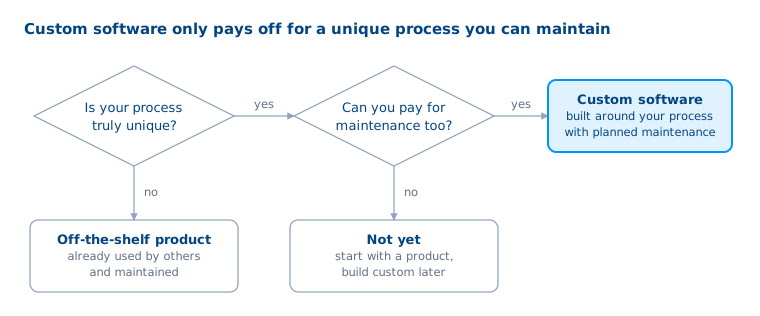
If you are just starting out, take what already exists on the market and use it. "Only when you are big enough to put €200,000-300,000 into a custom project and pay a dedicated team to maintain it is it worth building your own system," says Eduard Olariu. Until then, custom software makes sense for precise pieces: an integration, a payment flow, a connection between two systems that does not exist off the shelf.
Example: why Laundromat needed custom software
Laundromat runs a network of self-service laundries in Croatia. They needed every payment to be tracked in Stripe and invoiced automatically, following each country's rules: Romania, Croatia and Bulgaria have different requirements. On top of that, every payment had to be linked to a location and to the washing machine it was made on.
No product on the market did all of this together. So AITEH built the payments and automatic invoicing directly into the application Laundromat was already using. This is the typical situation where custom software is worth it: a very specific need, with no ready-made alternative.
Frequently asked questions
Which is cheaper: custom software or an off-the-shelf product?
In the short term, almost always the off-the-shelf product. The cost of building and maintaining custom software is paid by a single company, instead of being shared among many customers.
Can I start with a product and move to custom software later?
Yes, and it is often the safest route. You use a product, learn what you are really missing, and build only that part to order.
What should I receive when I commission custom software?
The source code in your ownership, documentation and a maintenance plan. Without them, you depend on the people who wrote it.
Can the two be combined?
Yes. Most often, an off-the-shelf product covers the common part and a custom integration covers the part specific to your company.