
Conscious business
How to use AI in your company: a practical guide for entrepreneurs
Where AI helps a business, how to choose the first process and which mistakes to avoid. A practical guide for entrepreneurs, with real examples.
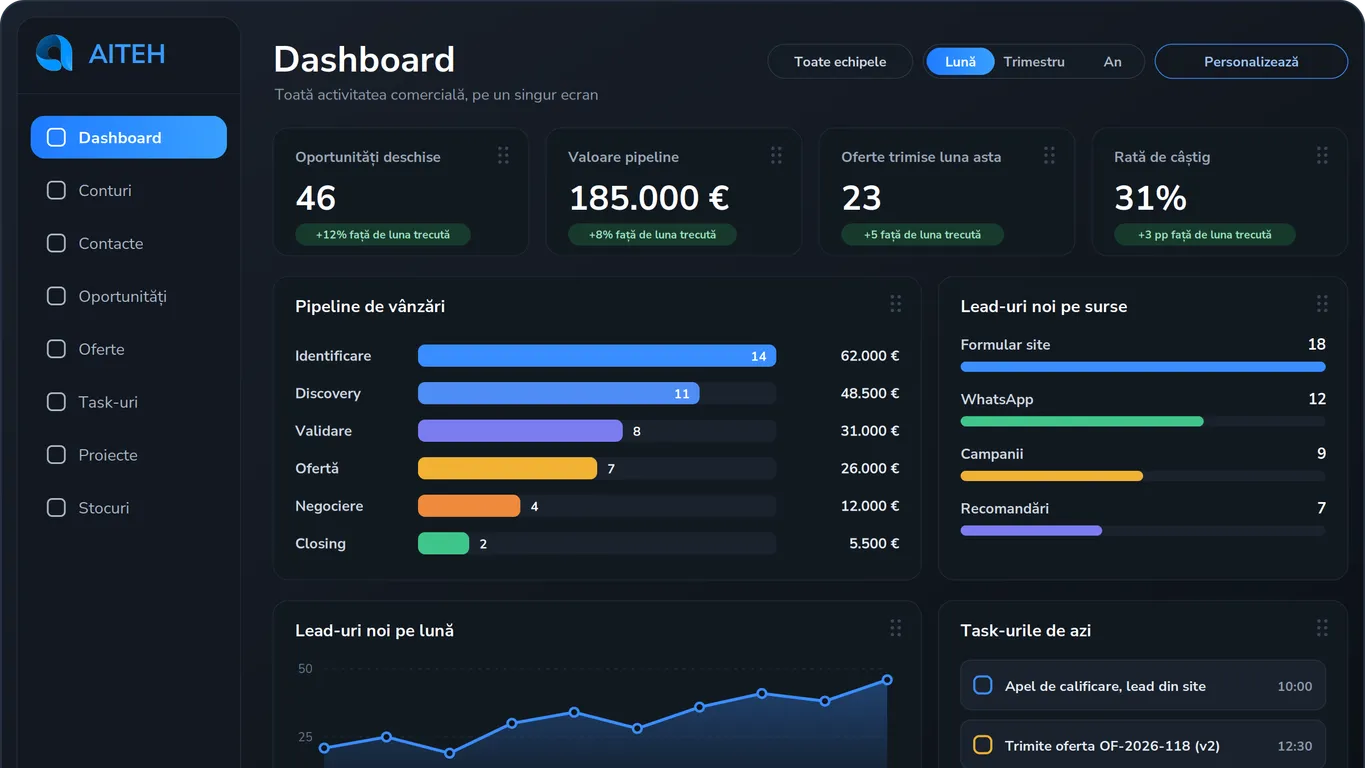
AI is used in a company on the processes that repeat and eat up time: replying to customers, data entry, reports, texts. You do not start with the tool. You start with the question: where does my business lose the most hours each week?
Many entrepreneurs have opened ChatGPT or Claude, asked for an email and stopped there. That is a good start. But the real value appears when AI becomes part of how the business works, connected to its data, with a person who checks the result.
In this article you will find where AI helps a business today, how to choose the first process, what we have built for our clients and which mistakes are worth avoiding.
Look at the business first, then choose the AI
AI placed on top of a chaotic process produces chaos faster. That is why at AITEH we look at the business first and only then at the technology.
A good process for a first step with AI has three signs: it repeats often, it follows the same rules every time and it takes someone hours each week. Answering the same customer question 30 times a day is a good candidate. A negotiation with a major client is not.
In practice, you start like this:
- Write down the process step by step, as it is done today, not as it should be done.
- Note how long it takes and who does it.
- Check where the data lives: in a system, in Excel, in emails or in someone's head.
- Choose the right level of AI (the three levels are below).
- Start with a single process, measure the hours saved, then expand.
1. Write down the process
step by step, as it is done today, not as it should be
2. Note the time
how many times a week, how long it takes, who does it
3. Check where the data lives
in a system, in Excel, in emails or in someone's head
4. Choose the level of AI
personal assistant, AI in the process or AI connected to systems
5. Start with a single process
measure the hours saved, then expand
then the next process
After the first process, you go back to step 4 with the next one: same rules, different process.
A good question to ask before any tool: do you know today how many hours a week your team loses on repetitive work?
Where AI helps a business today
In the companies we work with, AI gives back the most time in four areas.
Customer communication. An assistant on WhatsApp or on the website answers the questions that keep coming back, at any hour. When a question is complicated, it hands the conversation over to a person on the team.
Sales and leads. Requests from the website and from ads land in the system on their own, with no manual copying. A free-form message ("I spoke with Andrei from company X, he wants a quote") becomes a lead with the details filled in.
Marketing and content. AI writes the first draft of an article, a newsletter or a post. A person edits it and gives it the company's voice.
Admin and reports. Meeting summaries, data pulled from documents, reports that compile themselves. The owner sees the numbers without having to ask anyone for them.
The area where you lose the most hours is the place to start.
Your business
where do you lose the most hours?
Customer communication
answers on WhatsApp and on the website, at any hour, with handover to a person
Sales and leads
requests from the website and ads land in the system on their own
Marketing and content
AI writes the first draft, a person gives it the company's voice
Admin and reports
summaries, data pulled from documents, reports that compile themselves
You start from the centre: the area where you lose the most hours picks the first process.
Three levels of using AI in a business
Not every business needs the same thing. It helps to know which level you are on and what the next step is.
Level 1: AI as a personal assistant. You and your team use ChatGPT, Claude or Copilot for emails, texts, ideas and analysis. It costs little and you can start today. The limit: AI does not see the company's data, and everyone uses it in their own way.
Level 2: AI in the company's processes. AI does one precise task, the same way every time: it replies on WhatsApp, turns a message into a lead, writes the summary of a conversation. This is where the hours saved show up every month.
Level 3: AI connected to the company's systems. AI reads and writes in the management system, on the website or in the database. You ask for something in plain words and it happens: a new page on the website, an email campaign, a report.
Most companies we talk to are on level 1. The big gain comes from moving to level 2, on a well-chosen process.
Three levels of using AI
Tap a step to see what it means.
Level 2: AI in processes
- one precise task, the same way every time
- WhatsApp, leads, summaries
- hours saved every month
Each step requires better-organised data than the one before.
What it looks like in practice: examples from the companies we work with
[Frio](/en/case-studies/frio): debtors check their own debts on WhatsApp. The check button on the website was practically unused. We built an assistant on WhatsApp, the channel people already use every day. The debtor checks their situation, gets to payment or to a consultant, and every query reaches the team instantly as a work opportunity. No request gets lost anymore, not in the evening and not at the weekend.
The debtor
writes on WhatsApp
The assistant checks
the situation, at any hour
Goes to payment
through a button, from the conversation
Talks to a consultant
when the case needs a person
The team is notified
as an opportunity, right away
The debtor chooses the next step, and the team sees every request, however the conversation ends.
[Oana Teșoi](/en/case-studies/oana-tesoi): the website and emails are done through conversation. For the Punte de Legătură programme we built a system in which Oana talks to Claude, and Claude edits the website and prepares the email campaigns. What used to need a developer or hours of work in the admin panel now takes a few sentences.
AITEH: we use what we build. BizAITEH, our operational management system, runs in our own company. When we meet someone at an event, we send a WhatsApp message and the contact is already in the system, with our business card sent automatically. We know how a system like this gets adopted because we adopted it first.
Mistakes to avoid when bringing AI into a business
Automating a process you do not understand. If today everyone does the step differently, AI has no rules to work by. Put things in order first.
Leaving AI without a person who checks. AI sometimes gets things wrong, in a very confident tone. For anything that reaches a customer or touches money, someone on the team checks it or can take over at any time.
Putting customer data into uncontrolled tools. Copying personal ID numbers, contracts or financial data into a public chat is a risk. Personal data needs a correctly configured solution and a GDPR review with a specialist.
Buying the tool before the problem. A new subscription solves nothing on its own. The right question is "which process costs me the most time?", not "which AI should I get?".
Not measuring anything. Write down the hours beforehand. Without them, three months from now you will not know whether it was worth it.
Your first step this week
Pick a single process. Note how many times a week it is done and how long it takes. Check whether its data lives in one place. With these answers you already know whether AI can help you, and at which level.
Frequently asked questions
Do I need a large company to use AI?
No. Small companies gain proportionally more, because there the owner does many repetitive tasks alone. What matters is the process, not the size of the company.
Does my data need to be in a system for AI to be useful?
For level 1, no. For levels 2 and 3, yes: AI only works well with data it can read. Often the real first step is bringing the data into one place.
Is it safe to use AI with customer data?
It depends on how it is configured. For personal data you need a solution where you control where the data goes, plus a GDPR review by a specialist.
How much does it cost to bring AI into my business?
It depends on the process and the level. A personal assistant costs a monthly subscription. An automation tied to the company's systems is estimated once we understand the process.
Will AI replace people on my team?
In the companies we work with, AI takes over the repetitive work. People stay on what requires judgement: customers, negotiations, decisions.
Want to see where AI would help your business?
In 25 minutes we look at your business together and tell you honestly where AI makes sense and where it does not. No cost. If we cannot help you, we will tell you directly.