
Processes and automation
Before you automate with AI, look at your processes: 5 lessons from the chaos of small businesses
Chaos in a small business looks like a question shouted across the office. Five lessons on where the chaos comes from and why the process comes before AI automation.
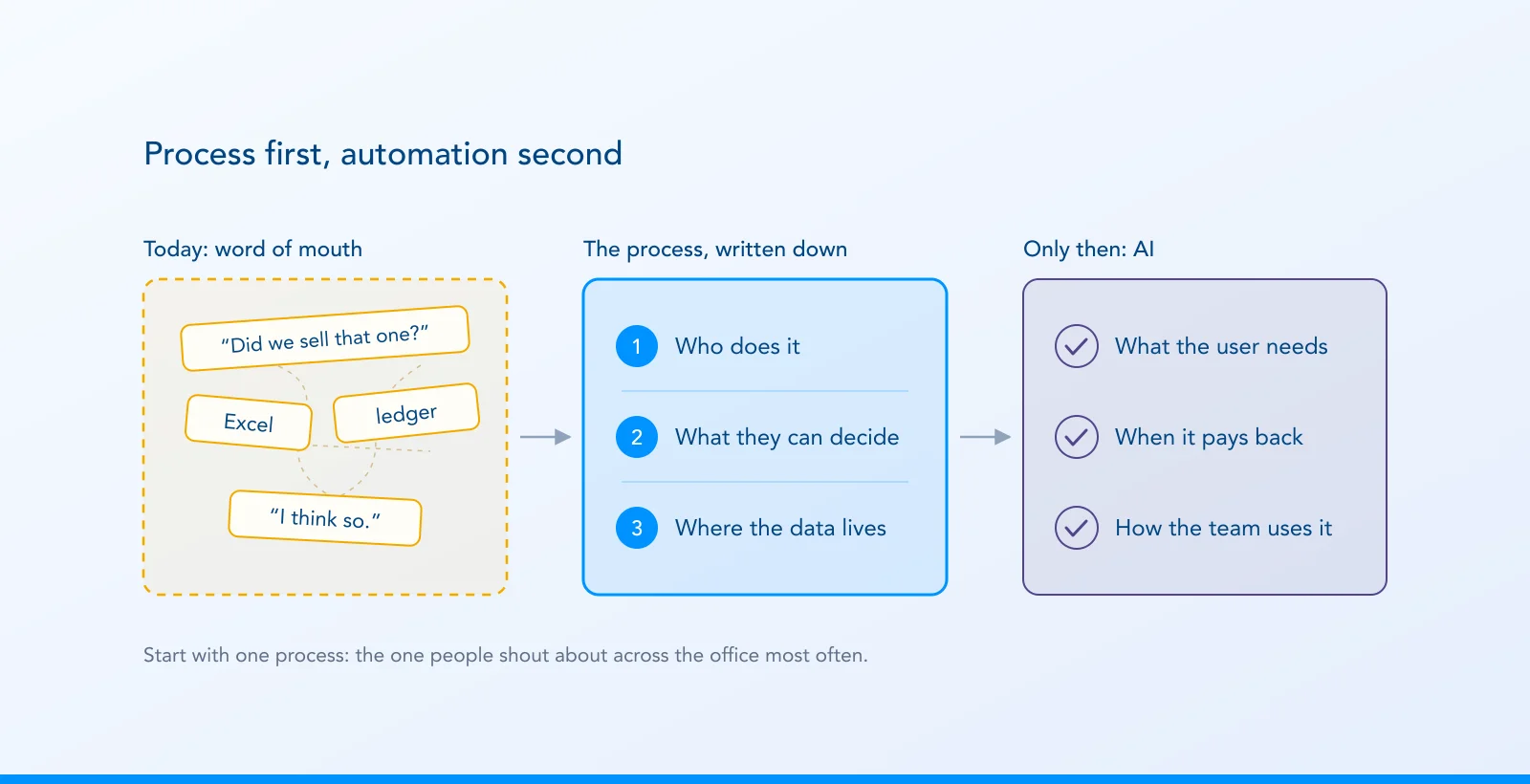
Chaos in a small business does not look dramatic. It looks like a question shouted across the office: “Did we sell that one?” “I think so.” Then someone opens an Excel file, checks a paper ledger too, and five minutes later the answer comes: “Yes, it’s fine, I’ve got it here.”
I saw this scene in a company that had invoicing systems and integrations with several online stores. The technology was there. The clarity was not. Since then I have learned a few things about where chaos comes from and how you get out of it.
1. Chaos comes from growth, not laziness
The business grows quickly and organically. The founder hires to win more of the market, and nobody stops to ask what the processes are. Everything is learned by word of mouth. What needs doing lives in each person’s head, and every step depends on one specific person.
It happens most in companies that put a lot of weight on people and almost none on roles. I believe both matter. People need to know clearly what they do, what they are allowed to do and where they have the right to decide.
2. Process first, automation second
We live in an “AI first” world, and many entrepreneurs lose money and time trying to automate everything. Before any automation, ask yourself three questions:
- What does the person who will use this actually need?
- How long until the investment pays for itself?
- How, concretely, will the team end up using it?
Without answers, you end up with automations nobody uses or, worse, automations that are useless. The same goes for the software you pay for every month that nobody opens.
3. DIY AI only gets you so far
In our company we build almost everything with AI too: quotes, tasks, dashboards, code. But we check what comes out. We hear more and more often: “I’ll build it myself, why would I need a software company?” Sometimes something that works really does come out.
The problems show up later. The solution does not scale, security goes unchecked, and a change in one place breaks something somewhere else. If you do not understand what is happening in the code, you find out only when it breaks.
4. Delegation has two halves
For a long time I was the firefighter of my own company. I delegated, but I was still the emergency contact, and I did not check: if someone said they would do it, in my head it was done. That is where the fires came from.
The first half of delegation is handing the work over and checking that it happened. The second is not taking it back. My colleagues kept me in check with a simple rule: “If we agreed on it, it stays.”
5. Problems repeat, at a different level
At the start I was short 2,000 lei. Now, after years of growth, the conversation is about tens of thousands. The difficulties look alike; they just get bigger with the level you have reached.
What keeps me going is the mission and perseverance: I look at what I have to do, I do it and I keep going until it works. And an old story about an emperor who wore a ring he looked at both when times were hard and when times were good. The ring said: “This too shall pass.”
Where to start tomorrow
Take a single process in your business, the one people shout about across the office most often. Write down who does it, what they are allowed to decide and where the information lives. Only then ask yourself what is worth automating.